“Do you like rollercoasters?”
Getting tossed around and flipped over? That feeling that you’ve risen out of the universe, at only 20 metres above the ground?
Thrilling, right?
So what does that have to do with spice?
It sounds like a strange comparison, but according to Dr. Alissa Nolden, Associate Professor in Food Science at the University of Massachusetts Amherst, the connection is surprisingly simple: risk.
“There’s some work that’s been done looking at risk-taking behaviour,” she explains. “Individuals who like taking risks get more enjoyment or fulfilment after doing so.”
In other words, if you love rollercoasters, you might also love chilli heat.

What Do We Actually Mean by “Spicy”?
Before we dig too deep into this topic, Dr. Ni Yang, an Associate Professor in Flavour Science at the University of Nottingham, clarified the concept of what spicy food is.
Dr. Yang observed that the term “spicy food” often leads to confusion, particularly in the UK. While many use the word to describe the broad, aromatic flavors of various herbs and spices, she argues that for the purpose of understanding spice tolerance, the definition must be more specific: “spicy” should fundamentally refer to the heat derived from chilies.
This distinction is crucial because that specific “heat” is perceived differently by everyone, rooted in our genes. Genetic differences play an important role in spice tolerance, according to Dr. Linda Bartoshuk. She is an experimental psychologist and neuroscientist, and a professor at the Univeristy of Florida. She explained: “There are people we call super tasters. They perceive things to be about twice as intense as non super tasters do. Super tasters have more funky form papillae. These are the structures that hold taste buds on the anterior tongue – the part you can stick out. The fungiform papillae contain the taste buds. The taste buds are surrounded by pain fibers.”
Why Spice Feels Different for Everyone
“So the more taste buds you have, the more pain fibers you have in your tongue. If you’re a super taster, you’re feeling the burn of chilies at least twice as intense as other people do. ”
Dr. Bartoshuk also mentioned that Asians have more super tasters, and women are more likely to be super tasters.
Before you get disappointed by the fact that genetic characteristics partially sharpen your spice tolerance, Dr. Bartoshuk reassured us that we do not need to train our spice tolerance at all.
She pointed out this natural phenomenon called desensitisation. She illustrated this with a simple experiment: if you swab a spot on your tongue with Tabasco and let it burn for 15 minutes, the sensation eventually vanishes. If you then re-apply the sauce to that same spot, you won’t feel a thing. “You will have desensitised completely to that concentration of capsaicin within minutes,” Dr. Bartoshuk explained. For those who eat chilies daily, this becomes a permanent state: “You’re chronically desensitized to it and you don’t feel the burn as much.”
The Science of the Burn
Capsaicin is the active chemical compound found in chili peppers that produces a burning sensation. Dr. Yang explained that this compound specifically targets the TRPV1 receptor on our tongue, which is the part of our nervous system responsible for sensing heat and pain. “Once the capsaicin reaches the receptors and triggers the pain reception,” Dr. Yang said, “your brain starts to receive a signal feeling that your mouth is on fire.”
This “fire” is rarely a localised event; instead, it often triggers a full-facial physical reaction. Dr. Yang explained that this happens because of the specific way our facial nerves are wired. “On your face, you actually have those three nerves. That’s why it’s ‘tri-geminal,'” she said, “Those three nerves actually connect to your eye, to your nose, and to your mouth.” This interconnectedness is why a particularly spicy wing doesn’t just burn the tongue, but makes the eyes well up and the nose run. “You get water from all three areas,” Dr. Yang adds. “In the studies we conducted, we found there is a double amount of saliva secreted when you are having spicy food.”
This full-sensory experience is a result of what Dr. Bartoshuk described it as a complex “engineering circuit.” Our nerves don’t just sit side-by-side; they actively interact, sometimes even inhibiting one another to maintain a balance. She noted that because the ability to taste and process food is so vital to human survival, our bodies have evolved a fail-safe system. “Evolution has given us a mechanism that makes damage compensated,” Dr. Bartoshuk explained, “If one nerve path is weakened or damaged, other nerves’ sensitivity goes up.” This internal compensation ensures that even when our mouths are under the “attack” of capsaicin, our nervous system remains highly responsive and alert.
The paradox of this intense neural response is that, despite the alarms going off in the brain, our body isn’t actually in danger. Dr. Bartoshuk pointed out that while capsaicin is a powerful stimulant for pain, it does not actually cause tissue damage. The real risk, she suggested, is often our own reaction to the heat. “The problem with getting exposed to really high concentrations is that people tend to panic,” she warned. In a desperate attempt to stop the burn, individuals might inadvertently hurt themselves by trying to scrub the sensation off their tongues.

Your Body’s Built-In Safety System
Her advice for those who find themselves in over their heads is simple: patience. “The best thing to do… would be to be patient and wait for desensitisation and just try to keep calm,” she said. This composure is especially vital if the spice affects breathing—a frightening experience that can occur if capsaicin is inhaled. Dr. Bartoshuk pointed out that if you are still getting any air in at all, you will likely be fine. The goal is to remain level-headed and let the natural process of desensitisation take over.
While keeping calm is a useful tool for the occasional spicy meal, for many, this comfort level is built over a lifetime of cultural exposure. Dr. Yang observed that where you grow up fundamentally shapes your relationship with the chili pepper. “In my family and where I grew up (Sichuan, China), we always cook with chili,” she said, noting that the same is true for many cultures, such as those in India. This early and frequent exposure acts as a natural form of training. By having spice on the table every day, the “burn” becomes familiar.
Dr. Nolden agreed that this cultural immersion adds a layer of emotional depth to the experience. It isn’t just about building a physical tolerance; it’s about the environment in which that tolerance is formed. “In some cultures, we might have traditional foods or meals made with a lot of spicy ingredients,” Dr. Nolden explained. When that heat is tied to the rewards of family dynamics and shared traditions, the experience becomes a deeply rewarding part of one’s identity.
The “Spicy High”
Beyond the cultural connections, there is a literal biological “high” waiting at the end of a spicy meal. Dr. Yang describes the intense physical reactions—the sweating and the excess saliva—as signals to the body to cool down and recover from the perceived “fight” it has just endured. “After you have done that, your body is rewarding you for surviving,” she explained, “This survival response triggers a release of endorphins and dopamine, creating a sense of euphoria that explains why many people find the experience so addictive despite the initial pain.”
However, if the “fight” becomes too intense at the moment, you might look for immediate relief. While there are countless theories on how to kill the burn, Dr. Bartoshuk suggested that the most effective temporary fix is often the simplest: temperature. “The thing that works best is cold,” she noted, “If you sip cold water, it will finish the burn very quickly. As long as you keep putting it on your tongue, the burn will be suppressed.” This works by providing a thermal distraction for the nerves, though the relief usually only lasts as long as the cold liquid is in contact with the tongue.
You might be thinking that last time you drank a whole bottle of water after spicy food only made your whole mouth on fire. Dr. Yang and Dr. Nolden both pointed out the chemistry of the capsaicin molecule itself to explain this common frustration. “If you look at the chemical structure, it’s very hydrophobic,” Dr. Yang said, “It likes oil, not water.” Because capsaicin doesn’t dissolve in water, rinsing with a glass of water just moves capsaicin around your mouth rather than washing them away.
How to Cool the Burn (Properly)
This is where milk and other fatty foods come into play. According to Dr. Yang, an oil-based matrix, like the fats found in dairy, can dissolve capsaicin, making it harder to reach the pain receptors on your tongue.
Do you still think you cannot hack spicy food? Let me tell you loud and clear that you are capable! The goal isn’t to suffer through spice, but to understand it. Because once you do, the burn stops being a barrier and becomes part of the pleasure.
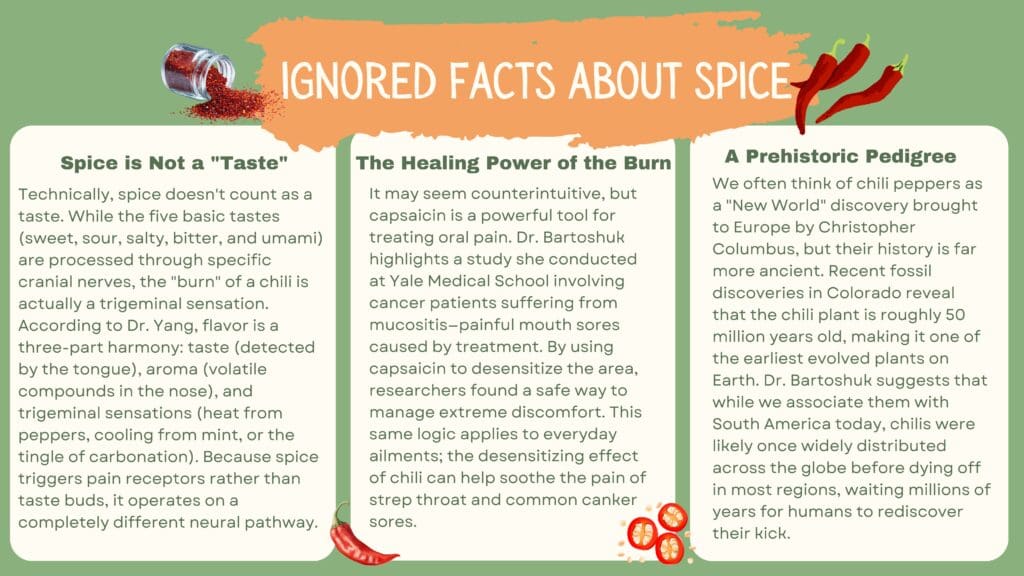
Ignored fact about spice
- Spice is Not a “Taste” Technically, spice doesn’t count as a taste. While the five basic tastes (sweet, sour, salty, bitter, and umami) are processed through specific cranial nerves, the “burn” of a chili is actually a trigeminal sensation. According to Dr. Yang, flavor is a three-part harmony: taste (detected by the tongue), aroma (volatile compounds in the nose), and trigeminal sensations (heat from peppers, cooling from mint, or the tingle of carbonation). Because spice triggers pain receptors rather than taste buds, it operates on a completely different neural pathway.
- The Healing Power of the Burn It may seem counterintuitive, but capsaicin is a powerful tool for treating oral pain. Dr. Bartoshuk highlights a study she conducted at Yale Medical School involving cancer patients suffering from mucositis—painful mouth sores caused by treatment. By using capsaicin to desensitize the area, researchers found a safe way to manage extreme discomfort. This same logic applies to everyday ailments; the desensitizing effect of chili can help soothe the pain of strep throat and common canker sores.
- A Prehistoric Pedigree We often think of chili peppers as a “New World” discovery brought to Europe by Christopher Columbus, but their history is far more ancient. Recent fossil discoveries in Colorado reveal that the chili plant is roughly 50 million years old, making it one of the earliest evolved plants on Earth. Dr. Bartoshuk suggests that while we associate them with South America today, chilis were likely once widely distributed across the globe before dying off in most regions, waiting millions of years for humans to rediscover their kick.
Now you have learnt a lot about spicy food, how about something sweet? Read exclusive article “Hooked on sugar: The science behind our cravings” by our writer Sam Juckes.