“I’ve always been interested in why people eat the way they do,” Ken Albala says, leaning back slightly, as if tracing the thought through time. “Not just what they eat, but what it means.”
For Albala, food is not just something we consume. It is something that tells stories, carries memory, and connects us to the past.
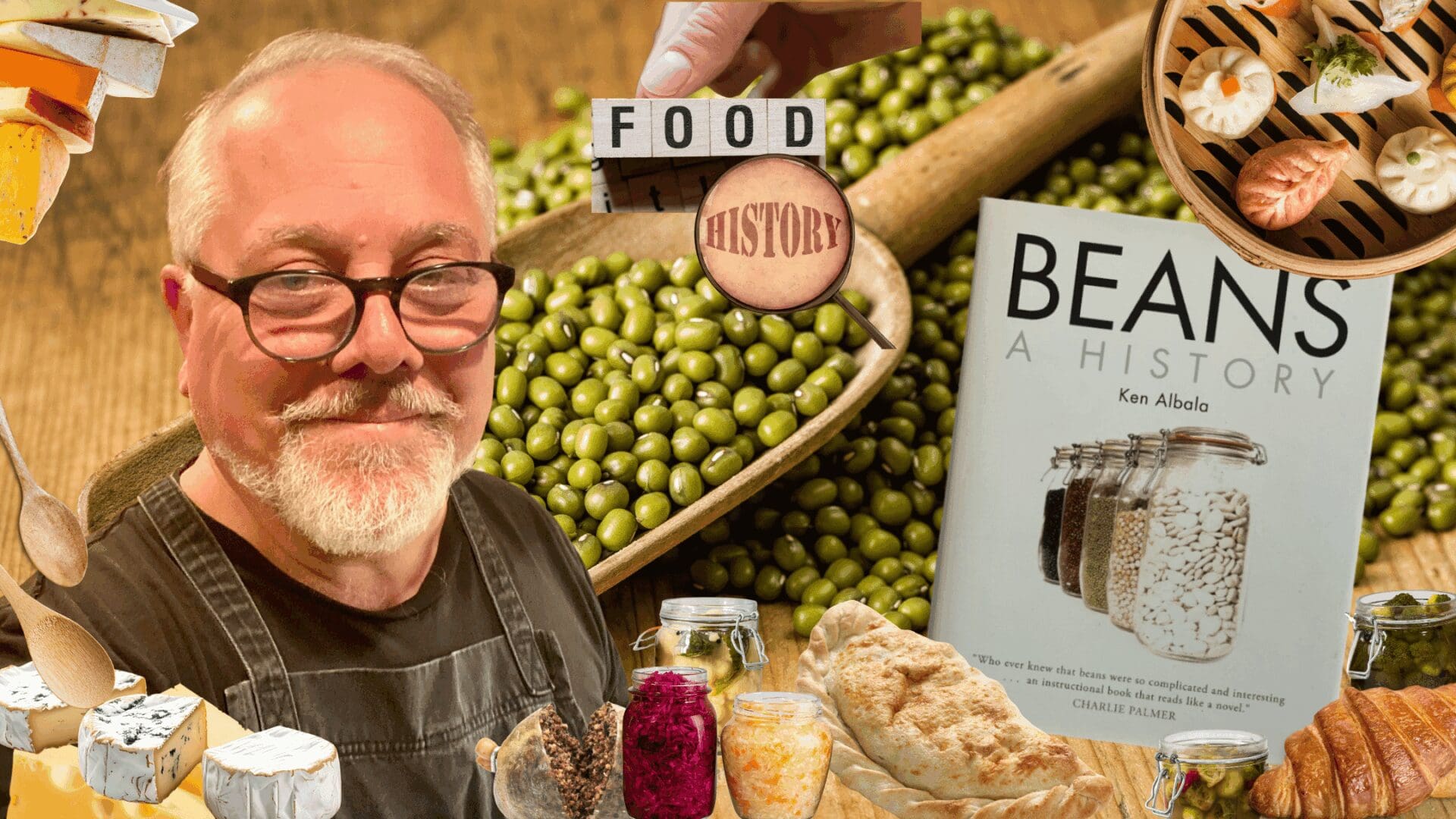
Dr. Albala is a food historian, a professor, and a prolific author whose work spans centuries and continents. He has written or edited over 30 books. He is the author of an award winning food history book, Beans: a Hisotry. His research explores everything from ancient banquets to modern eating habits
How it all started: accidentally stumbled into food
It was never really his plan to be called a food expert.
He did history for both his undergraduate and graduate studies.
“My training was in Renaissance history and I think it equipped me well to talk about food,” he tells me. “Food is about everything. It’s artistic, it’s political—it’s everywhere, because everyone eats.”
And when it finally did, it was not a carefully plotted career move. It was, quite literally, an accident.
At the time, he was deep into graduate school at Columbia University in New York, still deciding his dissertation topic. “My advisor said, ‘You need to pick a topic,’” he recalls. A simple instruction, but one that left him completely at sea. How do you choose what to dedicate years of your life to, when everything still feels open?
The advice he received next was – go across the park to the New York Academy of Medicine, because they have very comfortable chairs.
“And I was like—why? I’d never shown any interest in medicine.” he says smile slightly when recalling of it.
Still, he followed the suggestion.
The library, as promised, was beautiful. Quiet. Almost empty. The kind of place where time slows down just enough for curiosity to take over. This was before digital catalogues—research meant physically opening drawers, flipping through index cards, letting chance guide you.
And then, buried in those filing cabinets, he found a collection of around a hundred books on dietary theory, spanning roughly from 1450 to 1650. They had been gathered decades earlier by a woman in her 20s and donated to the library.
He then spent the next three years reading all of them.
That work eventually became his dissertation. Then his first book, Eating Right in the Renaissance.
Looking back, there’s still a sense of disbelief in how casually it all began. “I just stumbled into it,” he says. “It could have been anything.”
Big reveal: Google lied about being a chef
“I know, I know—it’s a lie,” he says, laughing. “Someone put that on Wikipedia.”
He points out that technically a chef is someone who runs a professional kitchen. He’s never done that.
But the denial only goes so far.
Because while he may not be a chef, food is still a daily practice. “I cook every day,” he says, almost casually.
And the way he talks about cooking makes that clear.
When I ask what he likes to cook, the answer isn’t a single cuisine or signature dish—it’s everything, all at once. Italian, Japanese, Mexican, German, French, Spanish. “I like everything,” he shrugs, though what he really means is that he doesn’t see borders the way recipes do.
He shared one of his recent creations. It started like a pizza. A dough filled with ground halibut and sturgeon, feta, kale, anchovies—folded into a large triangle, sealed at the edges. Salty, rich, layered. “It was really, really lovely,” he says, with the kind of satisfaction that doesn’t need embellishment.
It’s not quite Italian. Not entirely anything, really.
And that’s the point.
Knowing him: a peep into his experience
“I grew up in a food-obsessed family,” he tells me. “I don’t remember my grandma doing anything but cooking,” he says. The image is vivid: a cigarette dangling from her mouth, moving between pots with fat on her arms jiggling, feeding a household that prides herself on cooking.
If that was one side of his culinary upbringing, the other was quite different.
“My mother was a terrible cook,” he adds, laughing.
Somewhere between, he found his own way in. By the time he reached college, “I’ve cooked every day since,” he says.
“I don’t understand when people say they don’t like to cook,” he says. “That’s like saying you don’t like music or you don’t like reading.” He did admit that washing up is not the most pleasant things to do.
People think they don’t know how to cook so they opt out entirely, he suggests. They follow recipes rigidly, or avoid the kitchen altogether, worried about getting it wrong. But that, he argues, is exactly the problem.
“You can’t really learn from a cookbook,” he says. “If you always follow instructions, you’ll always need them.”
Instead, his approach is almost the opposite: start with ingredients, experiment, make mistakes. And eventually, cooking becomes quicker, easier.
It’s also, he insists, not as time-consuming as people think. Half an hour in the kitchen, he points out, is often no longer than ordering and waiting for takeaway. The difference is in what you get back: control, understanding, the ability to cook exactly what you want.
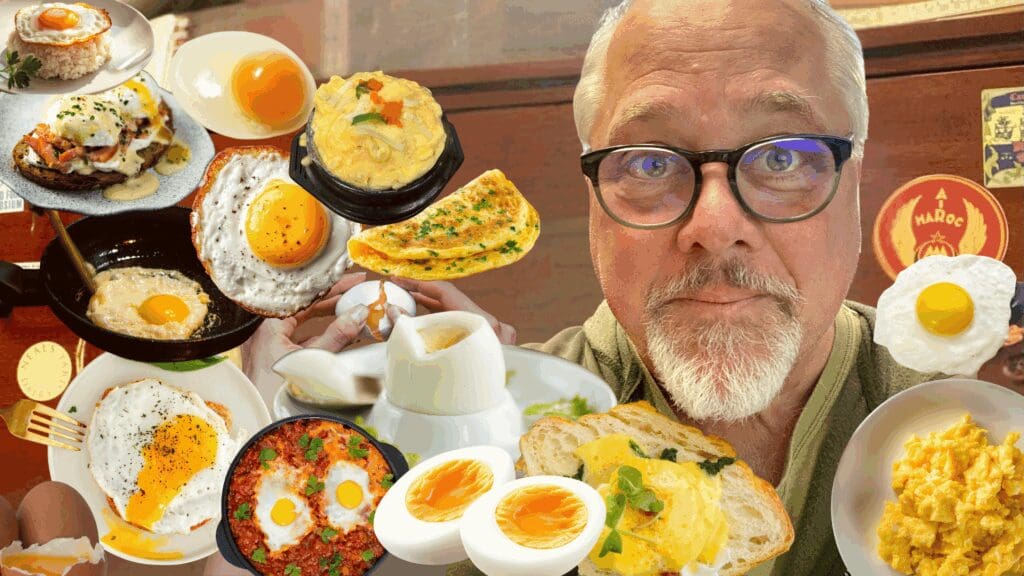
He also mentions: “I’ve always said the easiest thing to cook and the hardest thing to cook is an egg. Everyone eventually should know exactly how they like their eggs. But if you go out, you’re always going to be disappointed by the egg served.”
Favourite book: how it came to life
Ask him to pick a favourite book, and he hesitates.
There are too many, for too many different reasons. But one stands out as the most enjoyable to write.
The Beans: A History.
At the time, the single-subject food book genre was gaining momentum, and he had a growing suspicion that it wouldn’t last forever. Every ingredient, every topic, every niche, he thought, would eventually be taken.
“I just thought everything was going to be claimed,” he says. “And I better do one of these now.”
So he chose beans.
The result was the birth of an award winning food history book.
“It worked both as a scholarly text, but also as a popular read.” he says. “Which is really unusual.”
If The Beans was a book born out of anticipation, another favourite emerged almost entirely by accident.
The Lost Art of Real Cooking began, improbably, with an email about constipation.
A writer had contacted him asking for help with historical medical research on the subject, and whether he would be willing to contribute. He agreed. The assumption was simple: he would share references from his extensive archival notes on ancient dietary and medical theory.
So she came to his office with her assistance, Rosanna Nafziger Henderson who later coauthored the book with Dr. Albala.
“How interesting that food connects people”, Dr. Albana expressed, “I might only have met Rosanna in person 2 or 3 times, but our way of writing is so similar that we even need to mark each receipt with our names!”
Beyond the books: a life built around food (and everything near it)
Looking at his office, and you get a sense of him before he even starts speaking.
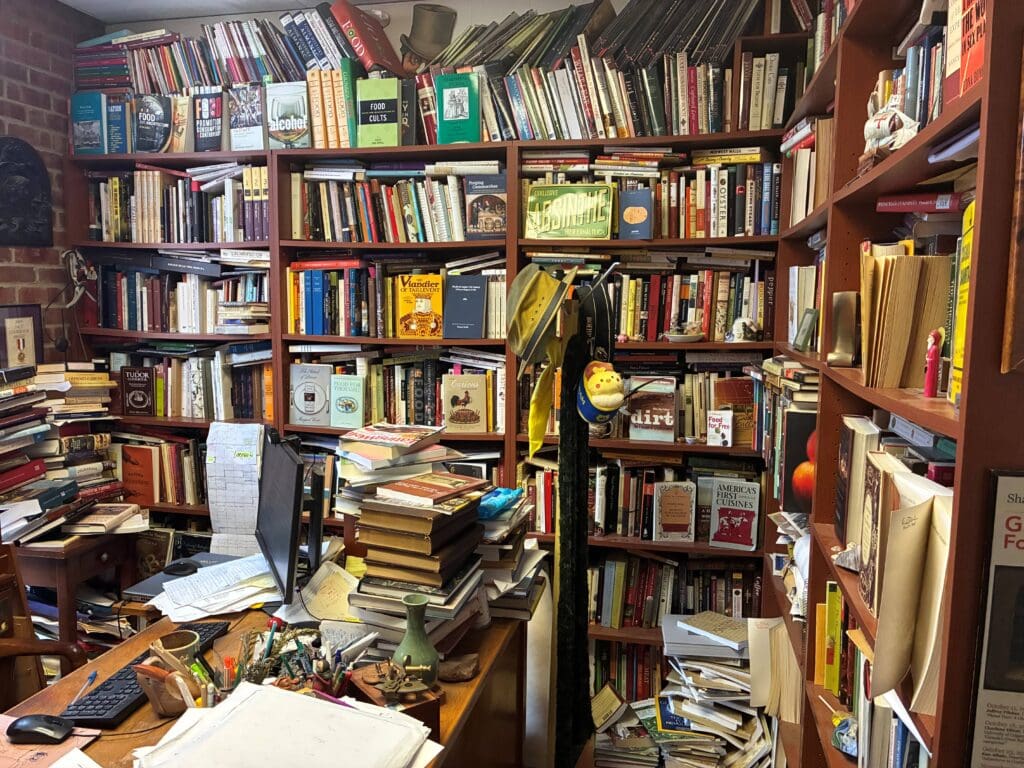
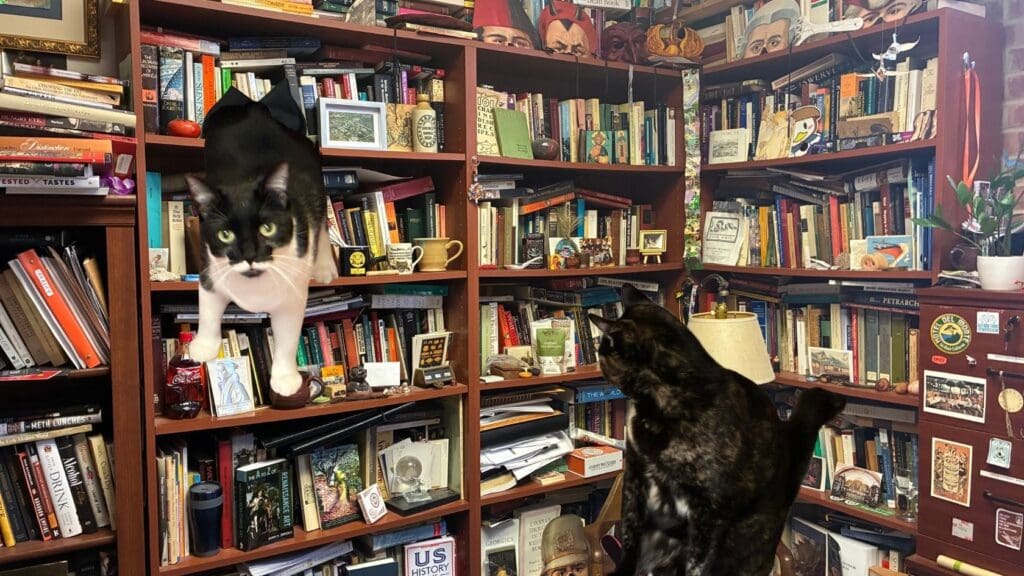
Books line every possible surface—stacked, squeezed, circling the room in all directions.“I don’t know what’s going to happen when I retire,” he laughs. “Where am I going to put all these?”
What attracts me the most are the stickers scattered along the edges of cardboard, odd little visuals that don’t quite match but somehow belong together—a cat holding pancakes, a walking fortune cookie, beer coasters, cookbook covers.
“Most are souvenirs, sent by friends or picked up during travels.” Dr. Albala says, “This is nothing, you need to see my car, it is fully covered in stickers!”
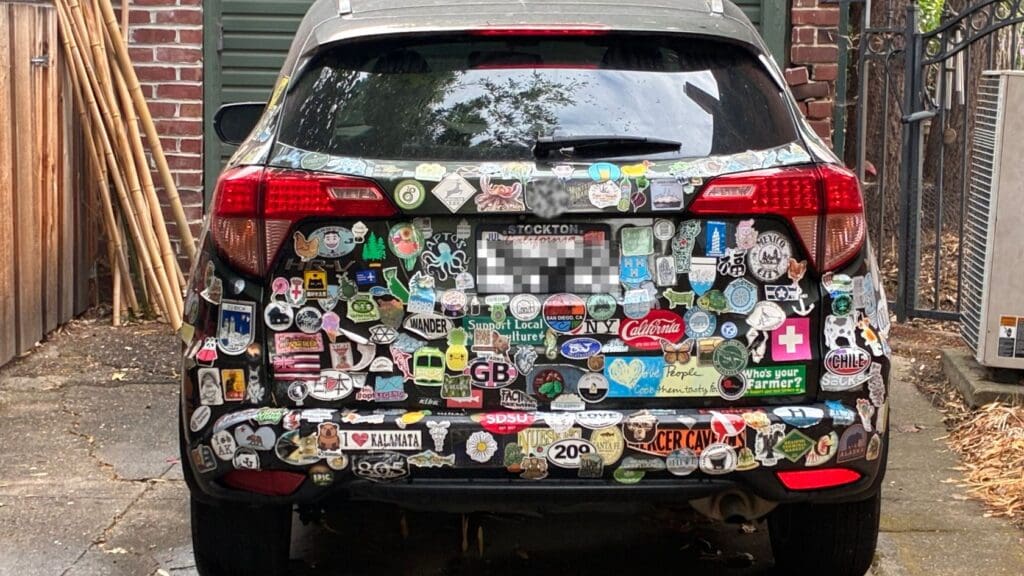
“I think everything I do has something to do with food,” he says.
For years, that meant pottery. He started it as a side interest during graduate school. He has made bowls, plates, and objects made to be used for food.
More recently, it’s taken another shape: carving wooden spoons.
He revealed that he wants to write a book on this soon.
He has two cats called Dora, and Calliope, and a big dog named Darwin.
A Taste of the Past
“The past is a fabulous place. Visit it often.” he says.
“Not with judgement, but with curiosity. Too often, we look back at historical food and dismiss it as strange or unappetising, something to laugh at rather than learn from. But that instinct misses something important.”
Instead of saying, that’s weird or that sounds disgusting. Try it. Follow the recipe. Taste it for yourself. You may find that people in the past had tastes just as refined, just as thoughtful, as we do today.
As exciting as it is to explore the global cuisines around us now, there is an even richer world waiting in history. A world full of unexpected combinations, bold flavours, and ideas that feel surprisingly modern.
So go back. Cook something old. Experiment in your kitchen, not just with what is new, but with what has been forgotten.
Because inspiration is not only about discovering the next trend.
Sometimes, it is about rediscovering what was already there.
To read how the kings used to eat by our writer Sam Jukes – The Food of Kings: Tracing the psychology of meat consumption.