Food has never been merely just sustenance. For centuries, what we eat has traced a history of identity, class, culture and struggle.
Hunter gatherers scoured the barren land to provide for their communities throughout the Stone Ages. The desired capture? Nutrient fuelled food, sourced from bordering animals. The desired result? Provision for their fleeting settlements based on unforgiving ground.
Rich in its content of most notably Iron, Zinc and vitamin B-12 (cobalamin), meat fuelled metabolism and powered early human evolution. The journey was long and treacherous, severe climate change and apex predators combined with starvation leaving little room for error. It was a hunt with potentially dangerous consequences, but with the promise of meat in sight it was a risk worth taking.
Long before brightly lit supermarkets lined every street and the rapid conveyance of food existed only as a glimmer of the imagination. For curiosity-driven foodies, this transformation provides us with a chronicle of who we are, where we’ve come from, and the leftovers of hierarchy that linger at the table.
Agricultural developments
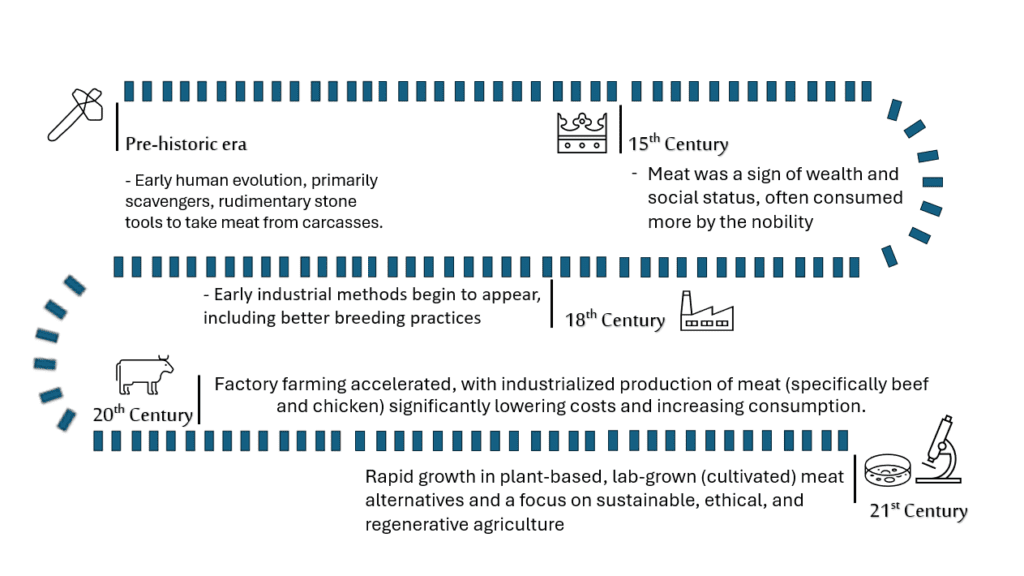
This initial form of consumption bore little resemblance to the meat we are familiar with today. From sourcing to consumption, necessity dictated humans’ earliest connection to meat, rather than convenience. Prepared with stone tools and bare hands. A contrast to the mere walk to the local supermarket and readily packaged produce we are faced with today. It wasn’t until a period of agricultural development that ensued thereafter, that meat progressed into anything familiar to that of today, with the introduction of breeding transforming the quality of meat to a more mass-produced commodity.
Nevertheless, research of the prehistoric era suggests meat still played its part as a key ingredient in the diet of humans, and biochemical work suggests its significance branched far and wide.
“The high percentage of animals, at almost all the sites I’ve worked at, makes me think they were mass feasting sites. And the work I have done suggests it wasn’t just the surrounding community doing this feasting, but much further afield,” explains Professor Richard Madgwick.
Professor of Archaeological Science at the University of Cardiff, Professor Madgwick has examined animal bones excavated across the country, including at the middens in Wiltshire and the Thames Valley, where evidence suggests people travelled far and wide to congregate for great meat feasts thousands of years ago.
But more poignantly, biochemical research shows the role of meat later proving to become far more than just food and instead transitioning into a striking marker of social significance.
“Research emphasises the importance of a shared community ethos and really points towards an egalitarian society at the time, and whilst dietary understanding is of course important, the mobility and social networks that were generated is really transforming our understanding of the time,” explained Madgwick.
Social Significance
Such associations between meat and its social significance can be traced back as long as civilization itself. From Ancient Romans with their presentations of elaborate banquets, filled with extraordinary meats ranging from peacock to parrot. To modern day traditions, such as the popular theory to the roots whereby the ‘Sunday Roast’ originated, with King Henry VII dining on roast beef alongside his royal guards, who later became known as the ‘Beefeaters’.
The phrase ‘you are what you eat’ couldn’t be more accurate.
The Tudor period more broadly provides a fascinating point of reference when assessing the role of meat and its association with sociocultural standing, with food at this time proving deeply symbolic.

Brigitte Webster and husband Tom (Credit: Brigitte Webster)
Food Historian, Brigitte Webster is the founder of ‘The Tudor and 17th Century Experience’, a business venture she runs in Norfolk with her husband, Tom, offering 17th Century themed retreats, specialising in food of the period. “One of the main factors affecting the daily culinary experience with meat was class, especially when you are talking before and after the reformation. For the lower classes, meat was limited to chicken or pigs, as everyone could keep their own pigs amongst lots of vegetables,” she says.
Today, the meat that is readily available spans a vast spectrum in price, dictated by weight, location, production methods and tenderness of each cut. And such a fact has always proved true.
“A typical recurrence that we saw after the reformation was people began wanting meat for every big occasion, but that combined with a steadily growing population meant the price rose sharply. Specific meats were seen as real wealth symbols,” Webster says.

And as regulation increased, sumptuary laws governed what people could eat further, only adding to the disparity between those of varied spectrums in class. “Sumptuary laws were important and it was more specifically about the number of dishes you were allowed to serve in one sitting. You had to earn at least £40 a year without labour (estimated value of around £30,000 today) to be entitled to have just four dishes per meal,” explained Brigitte.
With significant land required to attain such funds, much of the higher quality meat was restricted to only the most privileged.
“It has never not existed. Meat has definitely been a status symbol throughout history. And it’s not just the meat itself, but how you cook it. If you were in a noble household or somewhere with money, they are going to give you a choice of meat,” Marc Meltonville said on the connection between food and status.
Marc Meltonville is a food historian with experience researching culinary history, including his work in the Tudor kitchens of King Henry VIII at Hampton Court Palace.
Marc says one of the key indicators of social standing was the time of year you would consume your meat, “most working people had very limited access in comparison, and this was largely related to the times of year it was killed. For an average farming type, they had to wait until November to decide what could survive the winter. But the first thing you would do when you have money is start having fresh meat at the wrong time of the year.” A clear indicator to your nobility dependent on the time of year you had access to the highest grade of meat.
For everyone else, meat remained aspirational, rationed and rare. It appeared only in times of celebration, limited to plant-based, grain heavy diets the rest of the time. Centuries later, the structures may have shifted, but the sentiment lingers. What we eat so often speaks volumes as to who we are, from Tudor banquets to modern day dining rooms, food continues to act as a shorthand to society.
A pillar of identity
And the significance of meat extends beyond just solely an identifier of social class, branching far wider as a poignant expression of identity.
Professor Rebecca Earle is an award-winning food historian, and specialist in how every-day activities shape how we see the world. “Food is a way of who we think we are and who we aren’t, it is absolutely everywhere, from the language we use to talk about different groups of people to all kinds of works of literature.
“What we eat is always changing, so often our identity is not the fixed thing that we think it is, it is always dynamic and not the same as a generation ago even if we think of a particular category. With meat, it is costly to produce in terms of resources, and it is why we see modern day drives for people to eat less of it,” Professor Earle said.
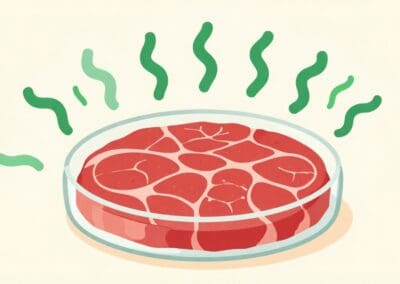
This brings us forwards into the present day, where sustainable alternatives are increasingly emerging, including the discovery of lab-grown and plant-based substitutes, a far cry from scavenging to science, with the newly discovered production of meat through the scientific growth of animal, plant or microbial cells in controlled conditions.
This shift marks a move away from centuries of systematic human-driven production to scientific innovation, with the backdrop of class, social standing, identity and culture shaped by the food on our plate.