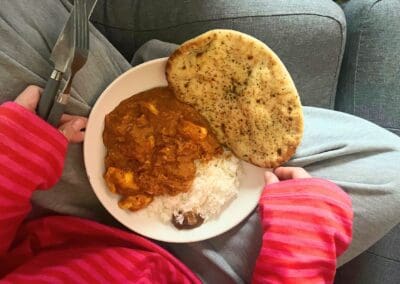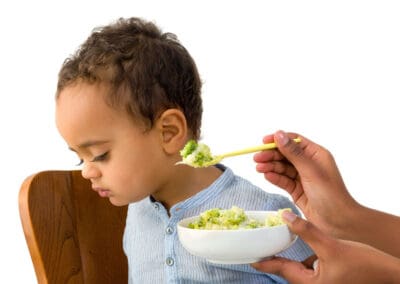
Plates are passed from hand to hand, and conversation fills the whole dining room. On a nice and rare sunny day with a gentle evening breeze, a family gatheres around the dinner table sharing a feast. It is the scene that modern advertisements, school textbooks, and television shows have long presented as the cornerstone of ideal modern family life.
A Declining Tradition?
But how viable is it? A study commissioned by the Week Junior in 2025 showed that only one in three families in the UK eat together everyday. In the world of busy modern life – afterschool clubs, digital entertainment, and unexpected overtime work, is the family dinner table an ancient tradition, or a cultural ideal that today’s society constructed?
For centuries, food has been more than what we need for survival. It is a cultural identity. Yet this familiar image is far from universal. Historians argue that the image of the harmonious family dinner is relatively modern.
According to cultural Historian Dr. Megan Elias, Director of the Gastronomy Program and Associate Professor at Boston University, the expectation that families gather around the table each evening is not as historically universal as it may seem.
Class, Culture, and Control
“It [Family dinner] actually wasn’t ever all that common. I would say it was around the early 20th century, middle class in the global north, kind of an ideal that everybody should be home specifically for dinner. Lunch and breakfast are not really in this cultural ideal,” she explains, “But the idea was this kind of normative family structure, all sitting around a table at a particular time. All eating at the same time was never accessible to a lot of folks.”
For many who are used to a nine-to-five working schedule, their everyday life could be a luxury for others.
Dr. Fabio Parasecoli, Professor of Food Studies in the Nutrition and Food Studies Department at New York University, explained further: “Family meal is an institution. It’s really something that emerged in the second half of the 19th century, and also only in certain classes. The working classes have always done what they could because it was dependent on work and where they were at the moment. But then with the idea of the patriarchal structure of the family became quite relevant in terms of respectability in bourgeois families. So there was also the desire of being these ideal families, through meals.”
“And that became sort of the ideal because, you know, it was the proper thing to do what people with money would do, and they would try to adapt to that.”
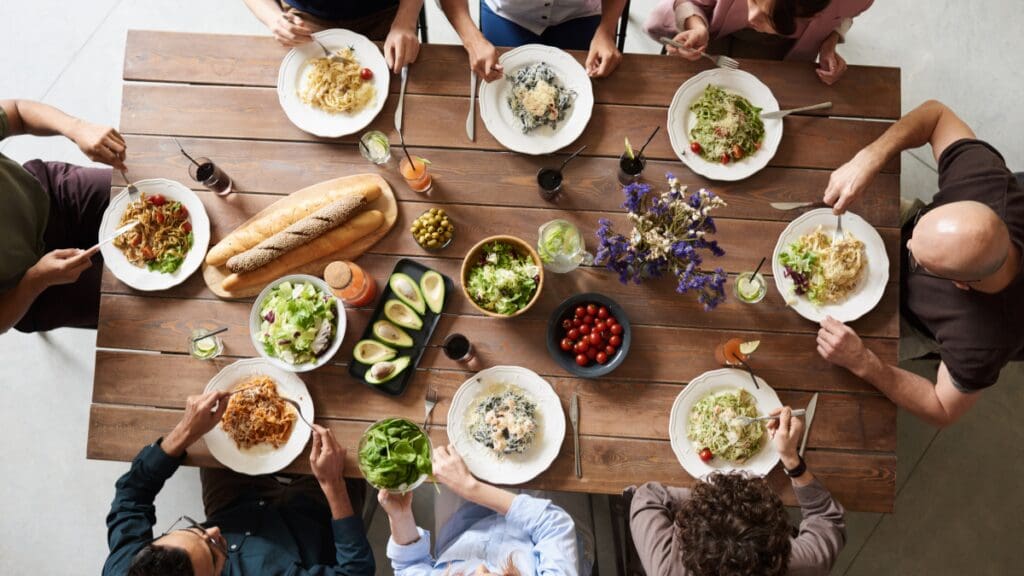
Despite the difficulties posed to families gathering together for dinner, many food advertisements still adopt the representation of an ideal family meal. Dr Parasecoli commented: “You see in advertising there is still this thing of the family meal. Of course,[nowadays], they try to make the family more multiracial, and more inclusive with the same sex family depicted. This has an appeal because in the reality of life, there is less eating together.
“Also, as we eat together, we might spend time sitting around the same table, but watching our phones or TV. The family meal doesn’t become a moment in which you ask the other person, how was your day or how you are doing. At one time, it was a practical way of cooking food and everybody eats around the table afterwards.”
When Entertainment Replaced the Table
In the 1950s, colour TV and modern entertainment started to dominate people’s free time. It brought humongous and rapid changes to society including family meals.
Dr Elias said: “Having that kind of entertainment (TV) in the home shifted attention away from dinner as the entertainment. And so people moved from their dinner tables over to in front of the television. That allows attention to be diffused. That’s the beginning of what we have now, people are eating with their phones or reading emails, watching videos etc.”
Why Eating Together Still Matters
Despite these changes, meals have long functioned as an essential part of human social life. Suzanne Higgs, Professor in the Psychobiology of Appetite and Head of the School of Psychology at the University of Birmingham, said: “One of the functions of eating together is that it allows us to strengthen social connections with people. The idea of eating together, being a kind of glue, helps with social cohesion. So opportunities including family meals for people to eat together might be important. Therefore, some aspects of wellbeing are involved.”
“This phenomenon of social eating might also be related to changes in hormones like oxytocin which is a hormone that is central to social bonding and affiliative behavior.” A study by the University of Southern California published in Nature Communications reveals that oxytocin signaling can increase in those social eating situations.
Apart from promoting our general well being and, frankly, making us happier, how we eat goes beyond habits and culture. Eating together may be deeply rooted in human biology. Dr Higgs explained: “When we observe other people eating, our brains are activating similar regions to those that are engaged during the act of eating. It’s a kind of mirroring of that brain activity. What that might then support is mimicry.”
“So essentially modeling or copying the behaviors of others, which is also known to promote affiliation and connection. So this sort of fits with a kind of broader social neuroscience finding around when we’re sharing behaviors, and that includes eating.”
Evolutionary Roots of Eating Together
With that being said, when you are reading this, a series of neurons in your premotor cortex are activated. According to neuroscientist and ethologist Dr. Pier Francesco Ferrari, Director of research at the French National Centre for Scientific Research (CNRS) and Associate Professor at the University of Parma: “The reason why you are motor facilitated through observing the people eating. It’s not just because you are hungry but because first you activate these areas of the brain that have to do with taking food, also to the same sensations of eating. From a cognitive point of view, you’re observing others and it’s a visual stimulus for your motor system.”
“So one idea is that, we use this resonance behavior that we resonate with others by simulating ourselves, a motor simulation.”
The motor system is the complex network of brain structures, spinal cord pathways, and nerves responsible for initiating, controlling, and coordinating voluntary and involuntary bodily movements. Research suggests this connection goes back even further.
Dr. Ferrari explained: “Ancient origin in terms of foraging behavior as a social activity in Homo sapiens (human), or chimpanzees, makes this tight connection between it and the pleasure of being together. The fact that this is really highly important for survival.
“Chimpanzees hunt together… The advantage of eating together shows that if you are in a social community, if you move together and someone finds food, the other would benefit from that.”

“There’s a kind of evolutionary reason for why we forage together, move together. So it’s a link. It’s a connection between eating and being social. This is something that comes from our evolutionary roots.”
Not Always a Perfect Picture
But while we are biologically wired to forage and feast in groups, the practical reality of the 20th century began to pull the table apart. Social changes have further reshaped the possibility of sharing a meal.
The World Wars expanded women’s roles beyond domestic and low-wage service work, accelerating a societal shift that eventually forced a rethink of traditional family structures. Dr Elias explains, “As more opportunities arise for women to enter the workplace, coming home and getting dinner on the table for other people is just not possible. And there’s no shift in male gender roles… so part of this kind of culture of independence means it’s just not feasible.”
In this sense, the decline of the family meal is not simply about busier schedules, but deeper structural changes in how families live and work. Dr Elias adds: “It can be very nice, if you like your family, to sit around the table and experience that. Sometimes families are an oppressive place. I think there’s a lot of pressure put on achieving that. It’s not easy to do, and it may be kind of overvalued in terms of what it can do for people.”
This tension between ideal and reality is echoed across disciplines. Dr Ferrari suggests that even the pleasure of eating itself is becoming more individualised, while Dr Higgs emphasises that although eating together can support wellbeing, “it doesn’t necessarily have to be in a very traditional way where people sit down at a set time around a table.” A proper and fancy sitting down dinner can be a lot of effort sometimes. Maybe next time, try something new and take your packaged lunch, enjoying it with your loved ones in a park.
A Simple Act, A Lasting Connection
The image of the family gathered around the dinner table may never have been as universal and common as we imagine. Yet its persistence suggests something deeper than nostalgia. In a world shaped by fragmented schedules and constant distraction, the simple act of sharing a meal may have become a luxury, but it is still possible. It offers something increasingly rare: connection.
Maybe it is time to send a message to your loved ones and organise a family meal or outing.
Knowing the benefit of dining together, do you want to know in more depth? Read our exclusive article by Larrisa Kirby, The Death of the 7 PM Dinner: Why Britain No Longer Eats in Sync.