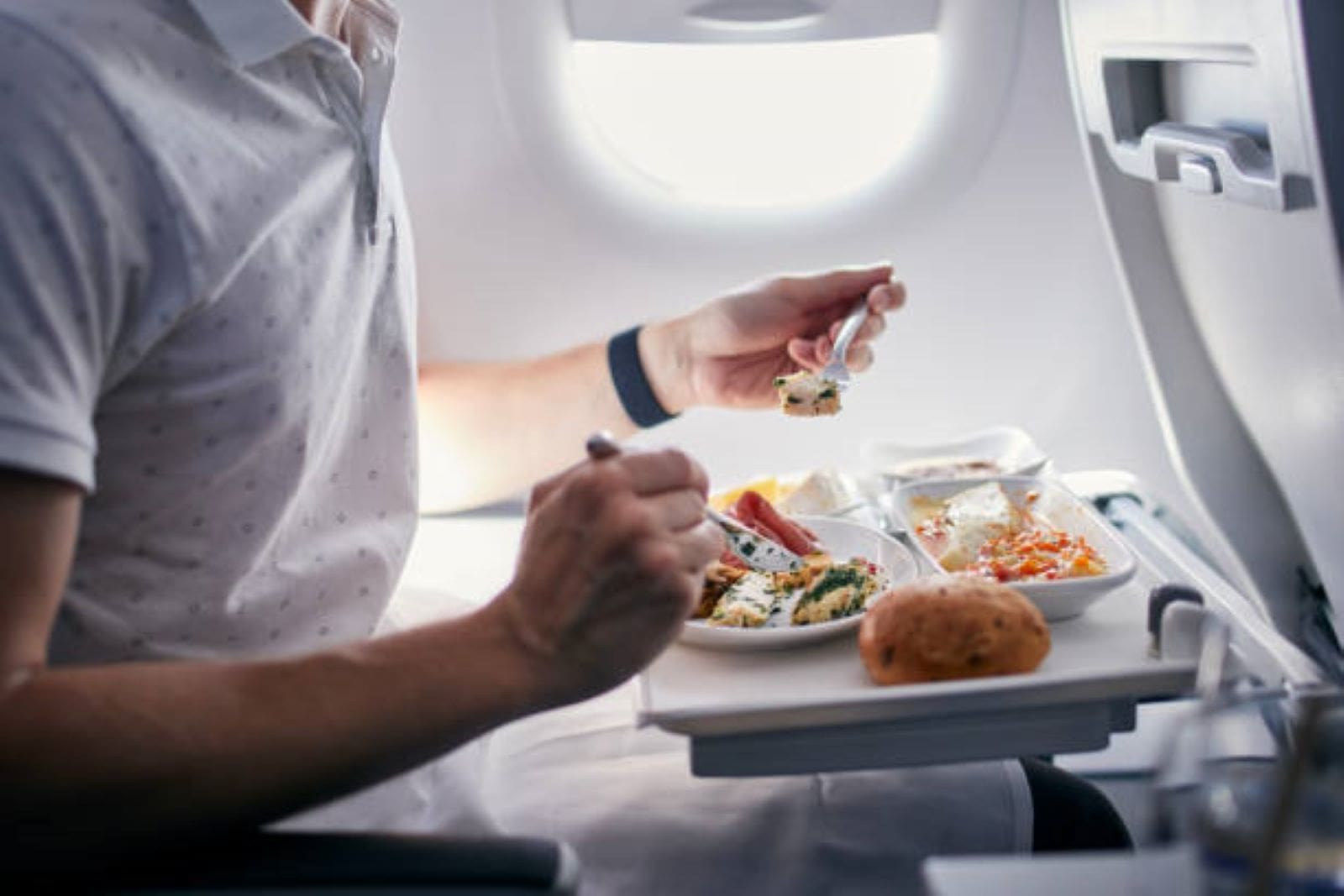
You’ve managed to secure the window seat (nobody climbing over you to head to the toilet, success!) and instead of listening to the safety briefing as you probably should, you flick through the in-flight menu. Perhaps a ham and cheese toastie for lunch might tickle your fancy or you could really push the boat out and go for the penne arrabiatta?
But as your lunch is served you’re met with immediate disappointment. The flavour is muted, the taste is dull and the meal that’s probably just set you back a good £8.99 has left all its flavour somewhere on the runway.
So what’s actually going on to change a seemingly flavourful lunch to a bland bowl of disappointment 35,000 feet in the air?
Rather than blaming airline catering, let’s look at the biological factors at play.
Professor of Food Science at Cornell University, Robin Dando explains that flavour itself is the result of many different sensory inputs combined. When even one of those inputs changes, it can affect the overall dining experience.
“A large factor that impacts our taste perception on airlines is the lack of humidity in the air. You remove humidity and in turn our sense of smell becomes a lot more limited and doesn’t perform as efficiently,” says Dando.
Without smell doing its job properly, our perception of flavour takes a significant hit. In fact, much of what we think of as ‘taste’ actually comes from aroma.
“If you think about the taste of a strawberry for example, it’s really just sweet and sour that you’re tasting, the rest of the inputs are coming from your olfactory senses (sense of smell).”
“Interestingly enough though the taste of strawberry versus a pineapple is essentially the same. They’re both sweet and sour. The characteristics that make a strawberry a strawberry and a pineapple a pineapple are really coming from the aroma of them.” Dando explains.
Together, taste and smell work as a single system, when one is disrupted, the entire perception of flavour begins to unravel.
So, let’s ask the important question. What should we actually be ordering to give our taste buds the best fighting chance at altitude?
According to Dando’s own research APA PsycNet Buy Page, “sweetness was much more dull to people’s senses whereas umami flavour was much more intense.
“Think about the range of soft drinks on offer on a flight, what do they all have in common? They’re all sweet, and tend to lack some flavour. Whereas, tomato juice is much more savoury and has greater depth of flavour. It’s more appealing to people in a plane environment because they are experiencing an imbalance in taste and the umami flavour is being boosted.”
These findings were supported by a 2010 study conducted on behalf of German airline Lufthansa by The Fraunhofer Institute. They found that thresholds for sweet and salty tastes drop by 30 to 40% compared to on the ground. However, bitter and spicy flavours are far less affected.
Other airlines are taking note of these findings. Singapore Airlines is also taking steps to prevent them from falling short in this race for flavour. One of the most promising weapons is sous-vide. A cooking technique whereby sealing food in airtight bags and immersing them in hot water they are able to lock in the flavour more efficiently than ever before.
This shift in taste perception helps us to explain why tomato juice becomes an unlikely in-flight favourite.
Few people understand this in flight phenomenon better than the cabin crew.
Hannah Leven, air hostess for Emirates, certainly isn’t a stranger to dining in the sky.
“I can’t say I really see the appeal, but it’s definitely something people order. Bloody Mary’s are pretty common, particularly on a long haul flight. But you do get the occasional person who just orders straight up tomato juice. I can’t wrap my head around that one.
“The tomato juice thing is almost a cliche in the galley, but I do think it’s real. You get one person asking for a Bloody Mary and then someone else and then someone else. It’s like a domino effect.”
For the crew though, the initial novelty of high end catering and ‘dining in the clouds’ quickly wears off and is rapidly replaced by the wearying reality of the long haul grind.
“I don’t particularly look forward to the food I’m going to get on a long haul flight, I have to say the quality of the food we serve is generally very high, but as staff it does get pretty repetitive.
“I don’t know about a flavour burst, but when we land it feels like a luxury to be able to eat whatever. I think food tastes a lot more flavourful on the ground but that could be the exhaustion talking, after a long haul flight I’d eat anything and be grateful for it. I live in Dubai for work, but I’m originally from Manchester so when I’m really craving something it’s home comforts like a roast dinner that I’m after.” explains Hannah.
Clearly this longing for flavour isn’t just a cabin crew thing. It’s a direct response to the sensory vacuum of the cabin. A vacuum that Hannah sees passengers trying to fill in real time.
“One thing I have noticed is that I often get customers asking for salt, people frequently want to add salt to their food. Most meals tend to come with a sachet already but often people choose to add more.”
While Emirates passengers are reaching for the salt sachets to bridge the flavour gap, Charles Spence, Professor of Experimental Psychology at Oxford University, suggests the experience of eating on a plane goes beyond taste and smell.
“When we’re in the air the sound of the plane’s engines reduces salt and sweet tastes by about 30%. Whereas the mysterious fifth taste of umami, which you get by adding MSG to food, turns out to be enhanced in the air, as a result of the background noise.
To get the same taste in the sky as we do on the ground, airline caterers have to add 20-30% more sugar or salt to an airline meal.
Tomatoes are a very rich source of umami, so combining that with Worcestershire sauce which might go into a Bloody Mary is another example of a rich source of umami. What’s happening is people are almost self medicating, by ordering a drink which will stand up to the noise and change in pressure.”
While Spence highlights how background noise recalibrates our taste buds, Professor Dando suggests that the ‘crunch’ of your food is as much an auditory experience as a tactile one.
“In order to judge how crispy something is, when we bite into it we need to also hear that input from sound, ” he explains “so if you were to block someone’s hearing, like with the loud sounds of a plane engine, it would have a direct impact on how crunchy we think a food is.”
Ultimately, dining at 35,000 feet is a masterclass of sensory adaptation. What’s easy to dismiss as ‘bad airline food’ is actually the result of a much more complex biological drama where humidity and background noise take control.
In this state of sensory uncertainty where our senses are effectively under siege we may start to look for external confirmation.
“Although it’s important to note people do tend to take cues from their surroundings, so if you look to the passenger on your left and they’re sitting there with a stick of celery and Bloody Mary in hand you may be more likely to fancy one yourself.” says Dando
So the next time the cabin crew clears away that £8.99 bowl of disappointment, remember the fault didn’t lie with the penne, but the physics of the flight itself.
The science is clear. High altitude changes how we taste. So next time you’re on a flight, do yourself a favour and choose the stronger savoury flavours. After all, science has just given you the perfect excuse for a Bloody Mary!