Putting the myth to the test
Now, that science has been rebranded for the algorithm. “Eating your skincare” has gone viral, with carrots positioned as a natural route to glowing skin.
The idea that a diet rich in carrots could make you more desirable may sound unrealistic, yet research suggests that the golden glow associated with a high fruit and vegetable intake can be seen as healthier, and even more attractive, than a sun-induced tan.
Human faces are the most habitually exposed areas of skin, and contain an endless mosaic of social information. While skin colour varies widely both within and between populations, its cues of health remain surprisingly consistent across the globe.That’s largely down to pigments including carotenoids, found in carrots and other fruits and vegetables, which are linked to nutrition and are used across species as visible markers of health.
But as TikTok blurs the line between credible advice and wishful thinking, one question remains; is the carrot glow real or just good marketing?
Some of the biggest drivers of the trend are creators like Cassie Yeung whose “retinol carrot salad” racked up over 9 million views and later featured in her cookbook, ‘Bad Btch in the Kitch’ alongside Lainie Cooks, whose “eat your skincare” carrot salad pulled in more than 1.6 million views.
Tammy Weatherhead, who amassed over 7 million views claiming she maintains a youthful glow at 40 by “eating her retinol”. Zareefa Ahmed-Arije, who branded the trend “ingestible retinol”, have propelled the humble carrot, an excellent source of cheap fibre, into a salad for skin.
Dr Emma Widgeworth, a London-based dermatologist, cuts through that quickly: “You can’t “out-supplement” a poor diet or the absence of an effective skincare routine. There is no point taking lots of supplements if you’re still smoking, not wearing SPF, or eating a diet high in processed foods, excess sugar and alcohol.”
She wouldn’t want a client to rely on the advice of tiktokers, especially with bold claims that have been oversimplified and re packaged as an easy wellness hack.
This phenomenon is sometimes called a “carotenoid glow”, not just because it can mimic the suntan of a week soaking up the sun by a Grecian beach, its an inner glow as the carotenoids cannot be synthesised in the body. They are actually therefore a limiting factor for organisms, but they display other perhaps more beneficial cues, like signalling nutritional status and, by extension, foraging ability. The ‘glow’ broadcasts that you are well fed.
The idea goes way back, Darwins theory of sexual selection helps explain why certain traits, like bright colours, evolve for attraction rather than survival. Males and females of the same species often look very different, as males develop a bright plumage or complex behaviours to attract the more picky females who have higher investment stakes when breeding.
While natural selection focuses on survival and reproduction, sexual selection specifically relates to mating success, sometimes resulting in features that conflict with survival.
Carotenoids are what many species of birds and fish display brightly coloured, sexually-selected ornaments, based on. These yellow-red ornaments signal condition and bigger, brighter carotenoid ornaments are preferred by the opposite sex.
The logic is straightforward: a healthier partner is more likely to have better resources, fewer parasites, and stronger genes to pass on. In that context, visible markers of health demonstrate a lower chance of infection, a better immune system or more efficient heart and lungs, may be passed on to offspring.
Having yellow undertones in the skin, regardless of ethnicity, is a positive sign for humans too. Dr Ian Stephen and Dr David Perret found in their study of “Skin colour, pigmentation and the perceived health of human faces.” That across ethic groups people had a preference for high carotenoid pigments.
Most people associate skin colour with melanin, the pigment responsible for tanning, but carotenoids work differently.
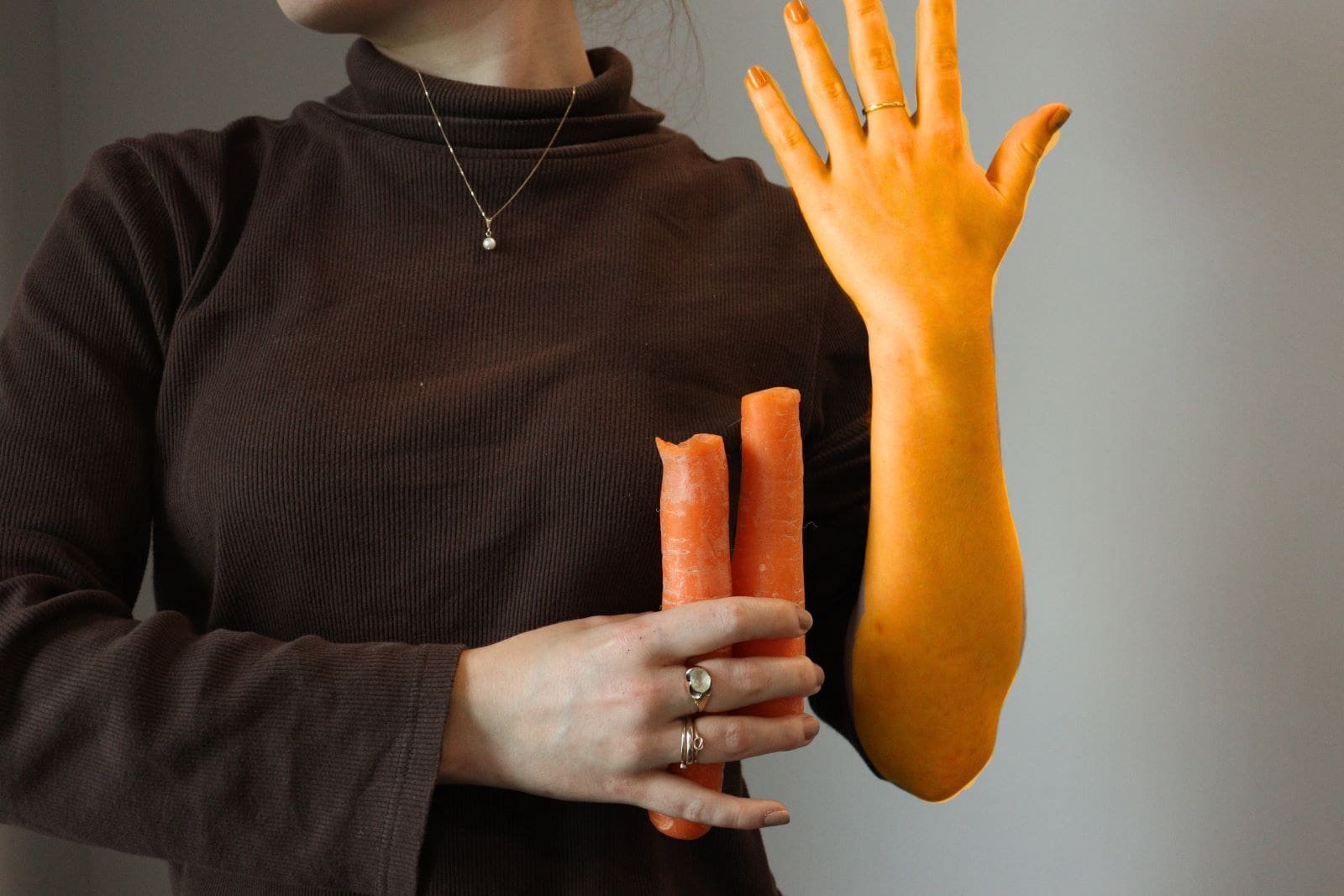
Dr Emma Widgeworth, a London based dermatologist said: “Clinically, diet-induced carotenaemia does not look like a sun tan. Carotenoids give the skin a yellow to yellow-orange tint, often most obvious on the palms, soles and around the nose. UV induced tanning produces a more diffused brown colour in sun-exposed areas, often alongside freckles and other photoaging changes over time.”
“From a dermatology point of view, diet really does matter for skin, but the focus should be on a broad range of colourful fruits and vegetables, to optimise dietary antioxidant intake, rather than chasing one ‘magic’ pigment.” There is no need to push intake to the point of carotenaemia, “I would be cautious about very high dose carotenoid supplements. Sensible sun protection will do far more for your skin in the long run than extreme dietary changes.”
Nutritionist Jo Travers, Author of The Low-Fad Diet & The Bone-Strength Plan said: “As with a lot of fads, there is a grain of truth that they are built on. Carrots can actually affect skin colour, giving an orange tone if enough are eaten. However they can also be addictive. I have had a client who was addicted and as a result had orange skin on her back. She had cravings and withdrawal when she tried to stop and likened it to giving up smoking. This is quite rare but still should be considered.”
Nutritionist Dr Jo said: “Eating a lot of carrots will obviously crowd out a lot of other foods meaning that a person may not get all of the polyphenols and fibres needed for health. Balance to a diet will always be much better for skin tone and elasticity, than focussing on one vegetable. ”
Study 1 shows that skin yellowness is greater in individuals that consume more fruit and vegetables and carotenoids. Study 2 uses spectral analysis to confirm that this effect is caused by increased carotenoid levels in the skin. (From Dr Ian Stephens thesis ‘skin colour pigmentation and the perceived health of human faces.’)
Research suggests that skin colour alone carries powerful social signals. Researchers measured the distribution of colour across women’s faces of different ages and applied these patterns to identical three-dimensional face models.
The faces were the same shape, and differed only in colour, yet participants consistently rated the “older” colour patterns as less attractive, less healthy, and older.
Similar findings found that perceptions of health in small patches of facial skin closely matched overall attractiveness ratings. Crucially, when researchers digitally adjusted skin colour and texture to appear more or less healthy while keeping facial structure unchanged, participants’ attractiveness ratings shifted accordingly.
Reddit users personal experiences demonstrate the real challenge of striking the balance.
@_brush:
“My mother loooooves mangos and papayas and I remember one summer she ate so many of them that her palms turned a yellow-orange color. It was hilarious. She continued to eat them knowing she’d go back to her normal color once the season ended.”
@cleverandcolorful
“drank carrot juice daily for about a month, which has a metric fuckton of beta-carotene in it. I did it because I just really like carrot juice. My skin turned a pretty healthy color at first (I am extremely pale) but then it turned orange with more and more consumption and was very itchy and dry. The lesson here is that some of it is good but too much is too much. I now have to limit my carrot juice consumption, unfortunately. That being said, if you don’t have the time/ motivation to eat your veggies then carrot juice is a good way to achieve this effect, just do so sparingly and do your research on too much beta-carotene consumption. I had someone ask if I was feeling okay because I looked like my liver was failing.”
Whilst the phrase “beauty is in the eye of the beholder” suggests that social conditioning and individual preferences control attractiveness, a growing body of literature suggests that people generally agree on which faces are attractive and which are unattractive, including cross-culturally and in societies with little access to Western media.
Jo added: “People love the idea of being able to do one thing to make their appearance “better”.
Just eat this one food for a flat stomach etc. It is definitely nothing new that diet and appearance are being linked. And it is definitely true that what you eat can affect the way you look and feel, however it’s getting a balance of all the things the body needs that really makes the most difference.”
The carrot glow might be real. But like most viral wellness trends, the promise is simpler than the biology.